



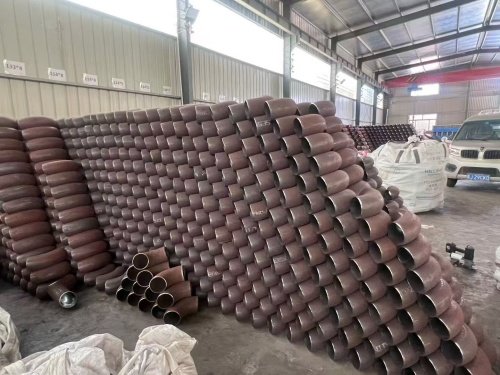
45° Long Radius Welded Steel Elbow Manufacturer & Supplier
The 45° long radius welded elbow represents a fundament […]
The 45° long radius welded elbow represents a fundamental component within the domain of fabricated carbon steel pipe fittings, engineered specifically for directional changes in utility, process, and general service piping infrastructures. This fitting is defined by its centerline curvature radius of 1.5 times the nominal pipe size (1.5D), a geometric parameter that establishes a gradual flow deflection path. This design choice is critical, as it effectively mitigates the abrupt momentum shifts commonly associated with short-radius configurations, thereby providing a favorable balance between spatial efficiency and hydraulic performance.
Manufactured in strict accordance with ASME B16.9, DIN 2605, and GB/T 12459, these elbows are designed for seamless integration into piping systems operating within low-to-medium pressure and temperature envelopes. It is essential to distinguish this product from its seamless counterparts; while seamless elbows are typically derived from solid billet piercing or hot extrusion processes, the welded elbow is fabricated from high-quality structural steel plates. This plate-forming methodology, coupled with longitudinal or spiral seam submerged arc welding, yields a fitting that combines structural integrity with significant economic advantages for large-diameter or non-critical service applications.
Geometric Design and Flow Dynamics
From an engineering fluid mechanics perspective, the defining attribute of the 45° long radius elbow is its favorable flow coefficient. The relatively gentle curvature effectively suppresses the formation of turbulent eddies and flow separation zones that typically occur downstream of sharper bends. In practical operational terms, this translates to a lower permanent pressure loss across the fitting when compared to standard short-radius or mitered bends. By maintaining a more coherent velocity profile, the fitting reduces the overall system head loss, which is particularly beneficial in long-distance transmission pipelines where cumulative friction losses directly influence pump sizing and operational energy expenditure.
Furthermore, the structural rigidity provided by the fabricated steel body ensures dimensional stability under fluctuating operational conditions. The smooth internal bore, a direct result of precision forming and finishing, minimizes shear stress on the conveyed medium, reducing the risk of erosion-corrosion in high-velocity services. This characteristic is especially relevant in slurry handling or systems where solid particulates are present, as the streamlined geometry prevents localized acceleration and impact wear.
Manufacturing Processes and Quality Assurance Protocols
The production cycle for this series of elbows commences with the selection of prime quality carbon structural steel plates. Prior to forming, each plate undergoes rigorous chemical composition verification and mechanical property testing to guarantee compliance with specified grade requirements. The fabrication sequence involves plate flattening, precision cutting, cold or hot press forming, and subsequent dimensional calibration to achieve the exact angular and radial tolerances stipulated by ASME B16.9.
Welding is executed using double-sided submerged arc welding (SAW) or gas-shielded processes, employing full-penetration joint designs to ensure homogeneous fusion across the entire joint thickness. Crucially, all welding procedures are qualified in accordance with ASME Section IX, and welders are certified to corresponding standards. Upon completion of welding, each fitting undergoes a strict regime of non-destructive examination (NDE). This protocol includes 100% radiographic testing (RT) and ultrasonic testing (UT) to detect and eliminate subsurface discontinuities such as porosity, slag entrapment, or lack of fusion. Additionally, post-weld heat treatment (PWHT) is performed where required—particularly for thicker wall sections—to relieve residual stresses induced during forming and welding, thereby restoring the material’s metallurgical structure and preventing stress corrosion cracking in susceptible environments.
Mechanical Integrity and Operational Durability
The inherent strength of the welded construction, combined with the toughness of the base material, endows the fitting with substantial resistance to mechanical loads, including bending moments and axial forces transmitted through the pipeline. The uniformity of wall thickness, consistently verified through ultrasonic thickness gauging, guarantees that the minimum required thickness is maintained even at the intrados and extrados of the bend. This ensures that the fitting exhibits comparable, if not superior, burst resistance to the straight pipe sections it connects.
Surface finishing, including the removal of sharp edges and the application of protective coatings, further enhances its service life. For applications involving mildly corrosive media, the smooth surface finish minimizes crevice corrosion potential. In cyclic service conditions, where pressure or temperature fluctuations are routine, the fitting’s robust construction and stress-relieved weld zone offer superior fatigue resistance, ensuring a leak-tight performance over extended operational cycles.
Application Scope and Economic Rationale
The economic viability of the 45° long radius welded elbow positions it as the preferred solution for a broad spectrum of non-critical and general industrial applications. Typical deployment areas include municipal water distribution networks, heating, ventilation, and air conditioning (HVAC) systems, cooling water circuits, fire protection lines, and chemical process piping handling non-hazardous, non-corrosive fluids. It is also extensively utilized in low-pressure oil and gas gathering systems and light industrial plants.
The choice of a welded fabrication route over a seamless forging is often driven by logistical and economic factors. For large nominal diameters (e.g., NPS 26″ and above), the availability and cost of seamless pipe make it commercially prohibitive. Conversely, the plate-forming method offers rapid production lead times, flexible customization for non-standard diameters or wall thicknesses, and a significant reduction in raw material waste. This manufacturing flexibility allows project engineers to optimize pipeline routing without being constrained by the limited availability of specialty seamless bends.
Installation, Interchangeability, and System Integration
Designed with standardized dimensional tolerances in accordance with ASME Class 150 and Class 300 dimensions, these elbows ensure seamless fit-up with mating flanges, valves, and adjoining pipes. The precision-machined bevel ends conform to ASME B16.25, facilitating ready field welding and minimizing post-weld alignment issues. This high degree of dimensional consistency translates to reduced installation time and labor costs.
In conclusion, the fabricated 45° long radius welded elbow provides a robust, cost-effective, and technically sound solution for directional changes in piping systems. Its design prioritizes flow efficiency, structural durability, and manufacturing reliability, making it an indispensable asset in the construction and maintenance of modern industrial infrastructure. The combination of stringent quality control, from raw material selection to final NDE, ensures that each fitting delivers predictable, long-term service performance, thereby safeguarding system integrity and minimizing lifecycle costs.
No technical specifications available for this product.
Oil & Gas Industry
Offshore platforms, subsea pipelines, refining equipment, and processing facilities. Excellent resistance to sour gas and chloride stress corrosion cracking.
Chemical Processing
Chemical plants, pharmaceutical production, pulp and paper mills. Superior performance in acidic and chloride-containing environments.
Desalination Plants
Seawater reverse osmosis systems, brine handling, and thermal desalination units. Outstanding resistance to chloride-induced corrosion.
Power Generation
Thermal power plants, nuclear facilities, and renewable energy systems. High-temperature strength and corrosion resistance.
Marine Applications
Shipbuilding, port facilities, and coastal installations. Excellent seawater corrosion resistance and mechanical properties.
Mining & Metallurgy
Slurry pipelines, ore processing, and tailings handling. Resistance to abrasive and corrosive media.