



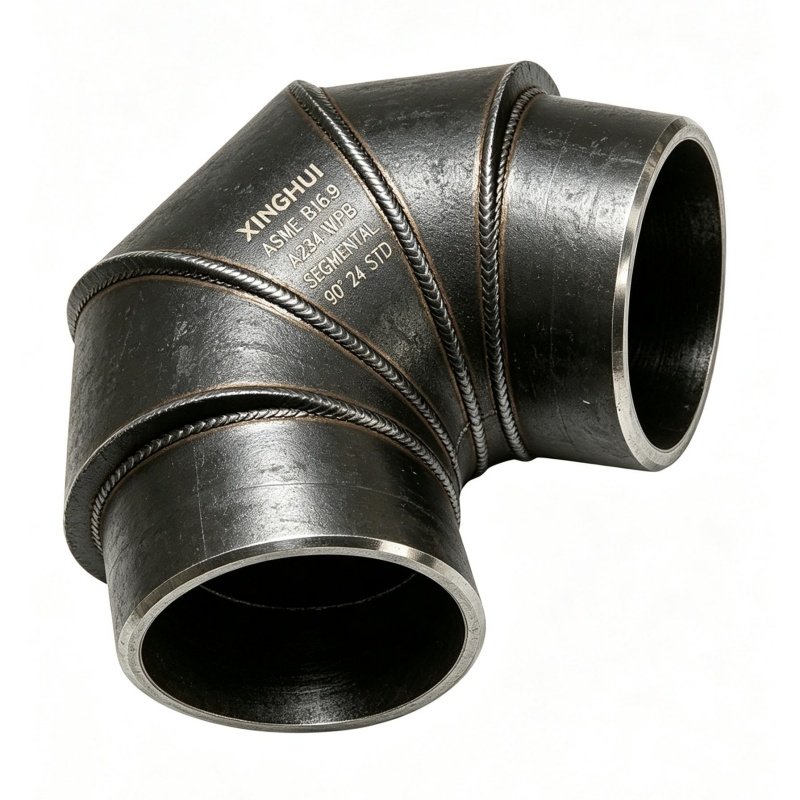
Fabricated Welded Steel Butt Weld Elbows (WPB, WP11, WP22, P91, 16Mn, Q355B)
Fabricated Steel Butt-Weld Elbows – Full-Range Material […]
Fabricated Steel Butt-Weld Elbows – Full-Range Material Grades & Heavy-Wall Capability for Critical Piping Systems
This product range covers fabricated butt-weld elbows manufactured from steel plate, formed by cold-pressing segmented sections and assembled through full-penetration welded joints. All dimensions and tolerances strictly follow ASME B16.9, and material selection complies with corresponding ASTM specifications as well as domestic GB/T standards. These elbows are specifically designed for large-bore piping where seamless equivalents are either unavailable or economically unjustifiable, particularly for diameters above DN600 and for wall thicknesses exceeding standard SCH schedules.
Material availability includes ASTM A234 WPB (carbon steel), WP11 and WP22 (Cr-Mo low-alloy steels), P91 (high-strength 9Cr-1Mo-V heat-resistant steel), alongside Chinese grades 16Mn (low-temperature pressure vessel steel) and Q355B (high-strength structural steel). This selection enables the product to serve a broad spectrum of service conditions, from ambient-temperature water and air delivery, through medium-temperature thermal oil and steam lines, up to high-pressure superheated steam and hydrogen service in refinery and power boiler applications.
Fabrication procedures are strictly grade-dependent. For carbon and low-alloy steel elbows, multi-pass symmetrical welding is applied using low-hydrogen electrodes, with controlled interpass temperature to prevent hydrogen-induced cracking and to minimize angular distortion. All welded seams are subject to 100% volumetric examination by ultrasonic testing (UT) and radiographic testing (RT) to detect and reject any internal slag, porosity, or lack of fusion.
For P91 material, a dedicated thermal processing regimen is enforced. This includes preheating to 150–250°C prior to welding, continuous interpass temperature monitoring not exceeding 300°C, and post-weld heat treatment (PWHT) carried out at 730–770°C with controlled soaking time based on wall thickness. The PWHT cycle is essential to temper the martensitic structure, relieve residual stresses from both forming and welding, and restore creep-rupture strength for long-term exposure to 570–620°C service temperatures. Hardness testing is performed on each heat-treatment batch to verify that values remain within the specified range of 190–250 HB, thereby confirming adequate ductility and resistance to stress corrosion cracking.
Geometric configurations include 45°, 90°, and 180° bends, available in long-radius (1.5D) and short-radius (1.0D) types. Special angles and non-standard center-to-end dimensions can also be produced based on project isometric drawings. Wall thickness options range from standard SCH 10 through SCH 160, and extend into heavy-wall custom designs with added corrosion allowance as specified by the piping stress engineer. End preparation includes beveling to standard 30°–37.5° with root face, suitable for manual or automatic gas tungsten arc welding (GTAW) root pass followed by shielded metal arc welding (SMAW) or submerged arc welding (SAW) fill.
All incoming steel plates are sourced from approved domestic and international mills, each coil or plate accompanied by a certified mill test report (MTR) documenting chemical composition, tensile strength, yield point, and elongation. These MTRs are reviewed against the required design pressure and temperature ratings before any cutting or forming commences. A unique heat number is assigned to each finished elbow, linking back to the original plate heat, welding consumable lot, and welder performance qualification records. This ensures full traceability from raw material to final dispatch.
Quality control beyond NDE includes dimensional inspection using surface plates, protractors, and inside-diameter gauges to verify out-of-roundness, wall thickness reduction at the intrados, and overall center-to-end dimensions per ASME B16.9 tolerances. Visual examination is carried out to detect surface cracks, undercuts, and arc strikes, all of which are repaired only with written authorized procedures. For P91 and other high-alloy grades, supplementary destructive testing – including transverse tensile, charpy impact, and bend tests – is conducted on production weld coupons to validate joint efficiency and toughness at both ambient and elevated temperatures.
These elbows are widely deployed in thermal power plant main steam and reheat piping, petrochemical furnace transfer lines, hydrocracker effluent systems, central heating network distribution mains, and large-scale industrial water transmission projects. Our manufacturing facility has accumulated over two decades of hands-on experience in large-diameter, heavy-wall welded fittings, supported by a dedicated quality assurance team and an independent third-party inspection option upon request.
Packaging for export adopts seaworthy wooden crates or steel pallets with inner protective coating, ensuring protection against corrosion and mechanical damage during ocean transit. Each shipment is accompanied by a complete documentation package, including material certificates (EN 10204 Type 3.1 or 3.2 as agreed), NDE reports, dimensional inspection records, and heat treatment charts. This documentation fully supports EPC contractor and end-user requirements for project submittals and final quality dossier.
By integrating flexible dimensioning, multi-grade material coverage, and rigorous process control, our fabricated elbows deliver a cost-effective yet highly reliable alternative to seamless fittings for large-bore and heavy-wall applications, meeting the demanding technical standards of modern industrial construction and turnaround maintenance projects.
Oil & Gas Industry
Offshore platforms, subsea pipelines, refining equipment, and processing facilities. Excellent resistance to sour gas and chloride stress corrosion cracking.
Chemical Processing
Chemical plants, pharmaceutical production, pulp and paper mills. Superior performance in acidic and chloride-containing environments.
Desalination Plants
Seawater reverse osmosis systems, brine handling, and thermal desalination units. Outstanding resistance to chloride-induced corrosion.
Power Generation
Thermal power plants, nuclear facilities, and renewable energy systems. High-temperature strength and corrosion resistance.
Marine Applications
Shipbuilding, port facilities, and coastal installations. Excellent seawater corrosion resistance and mechanical properties.
Mining & Metallurgy
Slurry pipelines, ore processing, and tailings handling. Resistance to abrasive and corrosive media.