



Plate Rolled Welded Steel Elbow (ASTM A234 WPB)
This range covers butt-weld elbows shop-fabricated from […]
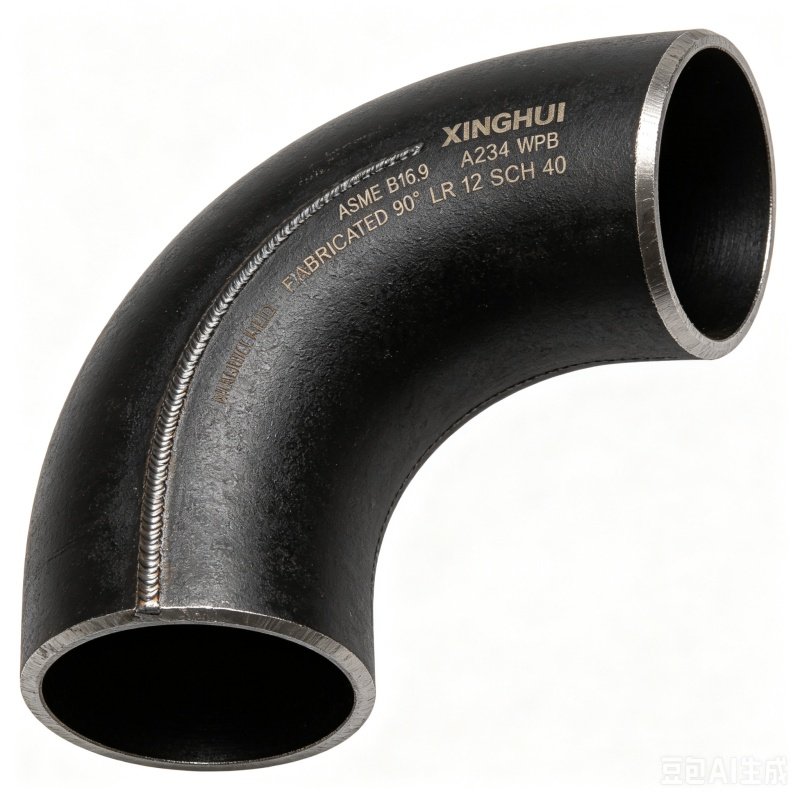
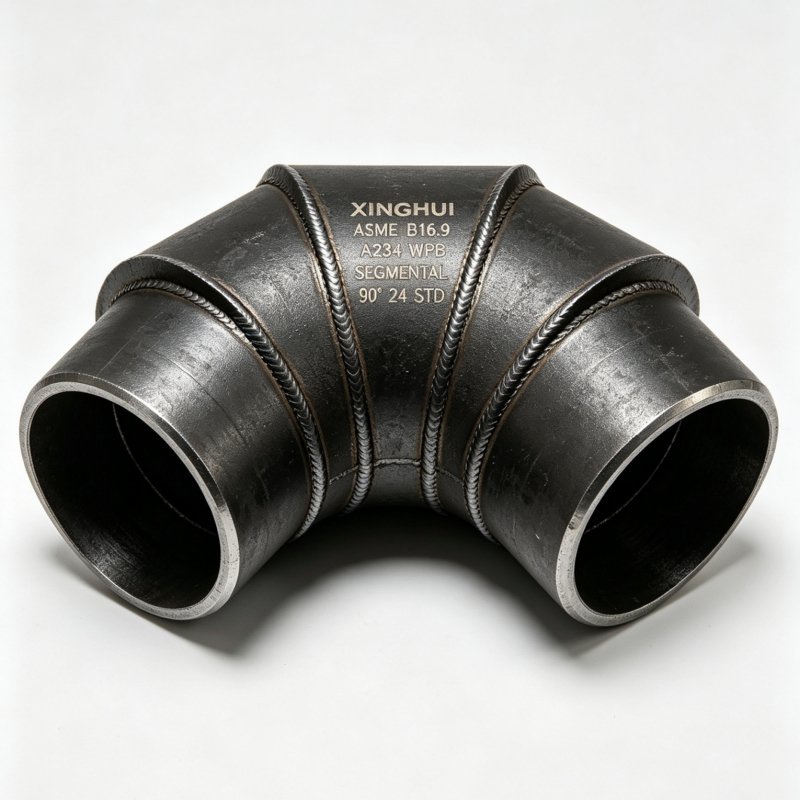
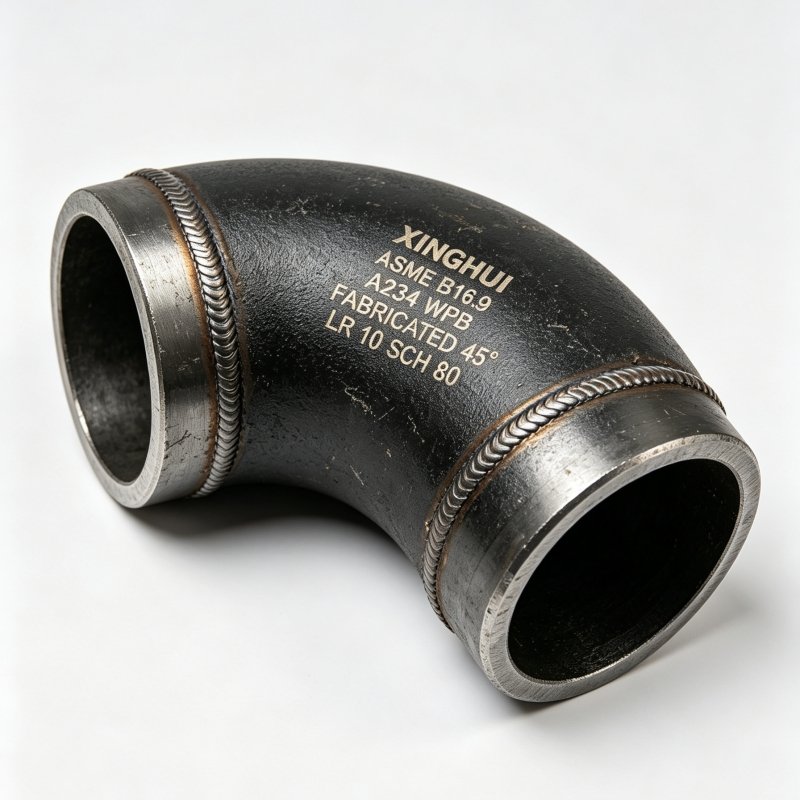
This range covers butt-weld elbows shop-fabricated from steel plate, rolled and welded, using ASTM A234 WPB as the base material. These are not seamless fittings, nor are they intended to replace seamless where bore sizes remain within conventional forming limits. Instead, they are purpose-built for piping circuits where nominal diameters exceed DN600, or where specified wall thicknesses surpass the capacity of standard seamless pipe and hot-extrusion tooling. In such cases, plate rolling and longitudinal seam welding offer the only practical route to produce a fitting that matches the parent pipe in both wall continuity and pressure-containing capability.
The manufacturing sequence begins with plate qualification. Each incoming coil or cut plate carries a fully traceable mill test certificate documenting heat chemistry, tensile properties, and reduction of area. Only plates with proven weldability – as reflected by carbon equivalent (CE) values below 0.45% for WPB – are routed to the shop floor. Plates are first stress-leveled to remove mill-induced curvature and residual flatness deviations, then marked, cut, and cold-formed into segmented gores or two-half shells, depending on bend angle and radius. The formed sections are dry-fitted to verify contour match, with joint gaps held within 0–2 mm and high-low misalignment not exceeding 10% of nominal wall thickness.
Welding is carried out using submerged arc process (SAW) for longitudinal seams and, where applicable, girth seams joining formed segments. All welding is performed in accordance with a prequalified WPS supported by corresponding PQR, covering essential variables including heat input, travel speed, and interpass temperature. For WPB, preheating is generally not mandatory unless ambient temperature drops below 5°C or section thickness exceeds 25 mm, in which case a minimum preheat of 100°C is applied. Multi-pass symmetrical welding sequences are employed to balance thermal input and minimise angular distortion. Post-weld, all seams undergo visual inspection followed by 100% ultrasonic testing (UT) in accordance with ASME Section V, supplemented by radiographic testing (RT) for critical service orders. Acceptance criteria follow ASME B31.3 or project-specific NDE levels.
Post-weld heat treatment (PWHT) is carried out at 600–650°C for a holding time of 1 hour per 25 mm of thickness, primarily to relieve forming and welding residual stresses. This step is particularly important for heavy-wall elbows where locked-up stresses could otherwise distort the final geometry or promote stress-corrosion cracking in sour service environments. After PWHT, the elbows are air-cooled uniformly to avoid reintroducing thermal gradients.
Dimensional inspection follows ASME B16.9, covering outside diameter at ends, wall thickness (minimum at intrados), center-to-end dimensions, out-of-roundness, and bevel geometry. End bevels are machined to ASME B16.25, with a 30°–37.5° included angle and a 1.6 mm root face, suitable for field TIG root plus stick or flux-cored fill. Special attention is paid to wall thickness thinning at the bend intrados; our forming procedure limits thinning to 12.5% of nominal wall, consistent with ASME design code allowances. For heavier schedules, we apply incremental cold-forming passes with intermediate stress relief to maintain wall distribution.
Hardness testing is performed on each heat-treatment batch, with WPB elbows required to fall within 140–197 HB, confirming proper tempering and freedom from hard spots. Surface examination covers undercut, arc strikes, and grinding burns – all of which, if detected, are blended or repaired under documented procedure, never by simple cosmetic touch-up. For orders requiring full lot certification, we include transverse tensile and guided bend test data from production coupons welded alongside the actual elbows.
These elbows are produced in 45°, 90° and 180° configurations, with long-radius (1.5D) as standard and short-radius (1.0D) available upon request. Size range typically starts from DN200 up to DN2000, with wall thicknesses from SCH 10 through SCH 160, and beyond for engineered heavy-wall designs with added corrosion allowance. Special angles and non-standard tangent lengths can be accommodated based on project isometric drawings.
Primary applications include refinery transfer lines, cooling water mains, steam distribution headers, firewater ring systems, and large-bore utility piping in power and industrial plants. End-users choose plate-welded construction not because it is cheaper than seamless – which it generally is, for large diameters – but because it is the only manufacturable solution for their specific bore-and-wall combination, offering full pressure-temperature rating compliance when fabricated under a controlled shop quality program.
All finished elbows are identified with permanent heat-number stamping, enabling full traceability from plate lot through welding consumable batch to final NDE reports. Export packaging uses steel pallets with timber framing, coated ends protected by plastic caps, and all documents – MTRs, WPS/PQR extracts, NDE records, dimensional reports and hardness logs – compiled in a single project-ready dossier. Third-party inspection attendance is welcome at any production stage, with advance notice.
With shop capability spanning plate thicknesses up to 80 mm and bend diameters up to DN2000, our fabrication line delivers consistent quality on both standard schedules and one-off custom orders. The process is not automated for speed; it is operator-controlled and inspection-gated, because in heavy-wall plate-fabricated fittings, reliability is built in one weld pass, one inspection hold point, and one documented release at a time.
Oil & Gas Industry
Offshore platforms, subsea pipelines, refining equipment, and processing facilities. Excellent resistance to sour gas and chloride stress corrosion cracking.
Chemical Processing
Chemical plants, pharmaceutical production, pulp and paper mills. Superior performance in acidic and chloride-containing environments.
Desalination Plants
Seawater reverse osmosis systems, brine handling, and thermal desalination units. Outstanding resistance to chloride-induced corrosion.
Power Generation
Thermal power plants, nuclear facilities, and renewable energy systems. High-temperature strength and corrosion resistance.
Marine Applications
Shipbuilding, port facilities, and coastal installations. Excellent seawater corrosion resistance and mechanical properties.
Mining & Metallurgy
Slurry pipelines, ore processing, and tailings handling. Resistance to abrasive and corrosive media.