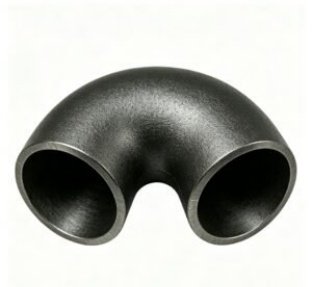
ASTM A234 WPB seamless butt-weld elbows are standard-gr […]
Price
$89.00/ Piece$129.00
Material GradeUNS S32750 / 2507
Size Range1/2" - 48"
Wall ThicknessSCH 10S - SCH 160
StandardsASME B16.9 / B16.28
Size *
Angle *
Wall Thickness
Quantity *
In Stock - Ready to Ship
ASTM A234 WPB seamless butt-weld elbows are standard-grade carbon steel wrought fittings, extensively deployed in industrial process piping, utility transmission and power engineering systems. All products are manufactured in strict adherence to ASME B16.9 dimensional tolerances, end configurations and pressure-temperature ratings, complying fully with ASTM A234 material specification requirements. Fabricated from solid seamless carbon steel pipe billets via integral hot forming, these elbows feature a monolithic structure free of longitudinal seams, circumferential welds and fusion bonding joints. Unlike plate-fabricated welded elbows, seamless WPB fittings exclude inherent weld discontinuities, heat-affected zone performance degradation and post-weld residual stress, delivering superior structural stability and fatigue resistance under cyclic pressure, fluctuating temperature and continuous operational load.
The forming procedure adopts precision-controlled hot-push thermoforming technology with standardized heating gradient, deformation rate and forced cooling protocol. This mature industrial process optimizes internal metallographic structure, ensuring uniform grain distribution, consistent wall thickness throughout the bend and tangent sections, and smooth internal and external surface finish free of pits, wrinkles and dimensional distortion. Pipe end sections are precision-machined to ASME standard butt-weld bevel profiles with strictly controlled root face and land thickness. Qualified end preparation guarantees complete joint penetration during field butt welding, maximizes welding joint efficiency, eliminates medium leakage risks, and secures long-term tightness and structural integrity of the entire piping network.
Our A234 WPB seamless elbow product range covers full industrial specifications, including 45°, 90° and 180° bending configurations in both long radius (1.5D) and short radius (1.0D) designs. Nominal sizes range from DN15 to DN600, covering standard wall thicknesses of SCH40 and SCH80, with custom heavy-wall and non-standard thickness options available to match specific project pressure design criteria and corrosion allowance requirements. All raw steel materials are sourced from certified mainstream steel mills, accompanied by official mill test reports that verify qualified chemical composition, tensile strength, yield strength and impact toughness for each production lot.
A rigorous lot-based quality control and full lifecycle traceability system is implemented for all finished fittings. Each batch undergoes comprehensive inspection procedures including dimensional verification, surface defect examination, hardness testing and mechanical property validation. Mandatory non-destructive testing, including ultrasonic testing and liquid penetrant testing, is performed to detect and eliminate internal inclusions, microcracks and other harmful discontinuities. Only fittings that fully meet ASTM and ASME industrial piping acceptance criteria are approved for packaging and shipment, ensuring zero defective products for engineering applications.
Benefiting from excellent ductility, reliable weldability and stable pressure-bearing performance, ASTM A234 WPB seamless elbows are the preferred fittings for oil and gas transmission, thermal power generation, chemical process systems, municipal water supply and drainage, and general industrial piping projects. As a professional manufacturer specializing in carbon steel seamless pipe fittings, we provide seaworthy export packaging, complete certification documents and inspection records. We support mass batch production and customized non-standard fabrication, delivering standardized, high-reliability piping solutions for global EPC contractors and end-users.
Scope and Field of Application
Seamless butt-weld elbows are wrought ferrous and non-ferrous pipe fittings manufactured without longitudinal seam welds or circumferential fusion joints, engineered to effect directional changes in pressurized fluid-conveying piping networks. The absence of fabricated weld seams distinguishes these components from welded elbows produced by plate rolling and longitudinal seam welding, conferring inherent advantages in pressure-retaining integrity, fatigue resistance, and corrosion performance. This structural distinction is not merely academic—it carries direct implications for code compliance, inspection requirements, and in-service reliability under cyclic loading and aggressive fluid exposure.
These fittings are specified for safety-critical and process-critical services where conventional welded construction is either prohibited by applicable design codes or deemed inadequate based on risk assessment. Typical installation environments include high-pressure steam generation circuits, sour-service hydrocarbon processing trains, subsea production manifolds, nuclear auxiliary coolant systems, and high-purity pharmaceutical or food-grade transfer lines. The selection of seamless construction is often mandated by piping classes that enforce the most restrictive interpretations of ASME B31.3, B31.1, or applicable offshore and marine design rules.
Material Grades and Specification Compliance
Our manufacturing program covers a carefully selected spectrum of corrosion-resistant and high-temperature alloys, each chosen for its demonstrated performance in specific chemical and thermal environments. The following material designations constitute our standard supply portfolio:
Alloy Designation UNS Number Distinctive Service Attributes
904L N08904 Exceptional resistance to reducing acid media; high resistance to chloride-induced pitting and crevice corrosion
Hastelloy C276 N10276 Outstanding performance in both oxidizing and reducing conditions; immune to localized attack in wet chlorine and hypochlorite systems
Monel 400 N04400 Superior resistance to hydrofluoric acid and rapidly flowing seawater; excellent in reducing environments
Inconel 625 N06625 High creep-rupture strength at elevated temperatures; excellent oxidation resistance and chloride SCC immunity
All products are manufactured in strict accordance with ASME B16.9 dimensional and pressure-temperature rating standards, coupled with the applicable ASTM material specifications—notably ASTM B366 for nickel-alloy fittings and ASTM A403 for wrought austenitic stainless steel fittings. Each production lot is accompanied by certified mill test reports per EN 10204 Type 3.1, with Type 3.2 documentation available upon request, detailing chemical composition (including trace element limits), ambient-temperature tensile properties, hardness values, and any supplementary corrosion test results specified in the purchase order.
Manufacturing Route – Hot-Pushing Seamless Formation
The production of seamless elbows from high-performance alloys poses substantial metallurgical challenges that demand precise process control. These materials typically exhibit restricted hot-working temperature intervals, pronounced strain-hardening coefficients, and relatively limited hot ductility—attributes that render conventional forming methods such as induction bending or cold pressing prone to producing surface defects, intergranular tearing, unacceptable wall thinning on the extrados, or buckling on the intrados.
Our established manufacturing route employs a specialized hot-pushing technique. A seamless parent pipe, conforming to the required nominal size and wall thickness, is heated to the alloy-specific forming temperature—determined through differential thermal analysis and empirical correlation—and then axially displaced over a heated, contoured mandrel. The mandrel geometry precisely defines the resultant bending radius and angle. This method ensures that the metal grain-flow orientation follows the final component contour, preserving mechanical isotropy and avoiding the discontinuity of properties associated with welded constructions.
Critical forming parameters—including furnace zoning, heating rate through the sensitization range, pushing speed, and the cooling profile upon exit from the heating zone—are continuously monitored and logged for each production run. These controls are essential to prevent undesirable phase transformations, such as sigma-phase precipitation in nickel-chromium-molybdenum alloys or chromium-carbide sensitization in austenitic stainless grades, which would otherwise compromise corrosion resistance.
Thermal Treatment Protocol – Solution Annealing and Stress Relief
Post-forming thermal treatment constitutes a critical determinant of final material condition and service performance. All fittings undergo a mandatory two-stage heat treatment sequence:
The first stage consists of solution annealing performed at temperatures specified by the relevant ASTM material standard and confirmed by alloy-specific phase equilibrium data. Soak times are calculated based on section thickness to ensure complete dissolution of secondary precipitates that may have formed during the hot-forming cycle, including intermetallic phases and grain-boundary carbides. Quenching is executed with controlled transfer times to avoid precipitation during cooling; the quench medium—water, polymer solution, or forced gas—is selected based on alloy sensitivity and section geometry.
The second stage is a stress-relief treatment conducted at sub-critical temperatures, selected to reduce residual forming stresses to acceptable levels without inducing phase transformations or sacrificing mechanical strength. Residual stress measurement, performed on witness samples using hole-drilling or X-ray diffraction methods, confirms the effectiveness of this operation.
Verification of heat treatment efficacy is performed through hardness profiling across the section thickness and metallographic examination of test coupons, including grain-size determination and assessment of precipitate distribution per ASTM E112 and relevant acceptance criteria.
Dimensional Scope and Configuration Availability
Our seamless elbow product line encompasses the following standard dimensional parameters:
· Bending angles: 45° (45EL), 90° (90EL), and 180° (180EL) configurations
· Radius classification: Long-radius (LR, centerline radius = 1.5 × nominal pipe size) and short-radius (SR, centerline radius = 1.0 × nominal pipe size)
· Size range: DN15 through DN1200, corresponding to NPS ½ through NPS 48
· Wall thickness: Standard schedules from Sch. 5S through Sch. XXS, with intermediate and custom wall thicknesses available to meet specific design pressure and corrosion allowance requirements
Where project specifications demand non-standard geometries—including reduced-radius bends, special end-to-end dimensions, or non-standard bevel preparations—we maintain full engineering capability to produce to client-supplied isometric drawings, piping class sheets, or design calculations.
End Preparation and Field Weldability
All pipe ends are machined to precise tolerances to provide butt-welding bevels conforming to ASME B16.25. The default preparation is a single-V bevel with controlled root-face width, included angle, and land thickness. Alternative preparations—including compound-V (double-bevel) and J-type bevels—are available for heavy-wall sections or where field welding procedures specify reduced weld-metal volume or particular joint geometries.
The precision bevel preparation ensures complete joint penetration when field-welded to mating components, achieving the joint efficiency factor of 1.0 assigned to seamless fittings in pressure design calculations per ASME Section VIII or B31 codes. Surface condition at the bevel and adjacent pipe-end areas is maintained to specified cleanliness and roughness requirements, facilitating defect-free root-pass deposition and eliminating potential sites for slag entrapment or lack-of-fusion defects.
Quality Assurance – Inspection and Non-Destructive Testing
Our quality system is structured around lot-based production surveillance with full material traceability from mill source through finished fitting dispatch. Each completed fitting is subjected to the following inspection and testing regimen:
· Dimensional verification: All critical parameters—outside diameter, inside diameter, wall thickness at intrados, crown, and extrados, center-to-end dimensions, and bevel geometry—are checked against ASME B16.9 tolerances using calibrated measurement instruments.
· Visual examination: 100% surface inspection per MSS SP-53, covering all accessible surfaces for the detection of surface-breaking discontinuities including laps, folds, cracks, and machining imperfections.
· Hardness testing: Conducted on each lot using Rockwell or Brinell scales appropriate to the alloy; results are compared against the specified range to confirm consistent heat treatment response.
· Positive Material Identification: Performed on each fitting using X-ray fluorescence (XRF) spectrometry to verify alloy grade and to detect any material mixing errors before final release.
Mandatory non-destructive examination includes:
· Ultrasonic testing (UT): 100% volumetric examination using both straight-beam (longitudinal wave) and angle-beam (shear wave) techniques, performed per ASTM A435 or ASME Section V Article 5. Acceptance criteria are set at the most stringent level applicable to seamless pressure components.
· Liquid penetrant testing (PT): 100% examination of all machined and formed surfaces per ASTM E165, using solvent-removable penetrant systems to reveal open-to-surface flaws.
All NDT operations are performed by Level II or III certified technicians holding current ASNT SNT-TC-1A credentials, with equipment calibration verified against reference standards before each examination session.
Documentation, Preservation, and Shipping Documentation
Each delivery is accompanied by a comprehensive documentation package that includes:
· Certified mill test reports (EN 10204 Type 3.1 or 3.2, as ordered)
· Dimensional inspection records with actual measured values
· NDE examination reports with operator identification and equipment details
· Heat treatment time-temperature charts with traceable recorder calibration
· PMI verification logs
Preservation for shipment follows standard export practice: fittings are individually protected against mechanical damage and corrosion, then packed in seaworthy wooden crates or palletized bundles with edge protectors and terminal caps. All packages are clearly labeled with purchase order number, heat number, size, schedule, material grade, and quantity, enabling unambiguous identification upon receipt at the project site.
Service Experience and Industry References
Our seamless butt-weld elbows are currently installed and operating in a range of demanding environments, including offshore production platforms (both topside and subsea), seawater reverse-osmosis desalination facilities, chlor-alkali electrochemical plants, fine-chemical synthesis units, pharmaceutical pure-water distribution systems, and refinery hydrocracker effluent circuits. Field feedback consistently identifies reduced maintenance requirements and extended intervals between scheduled inspections as direct benefits of the seamless construction combined with rigorous metallurgical control and comprehensive NDE screening. These operational advantages translate into measurable reductions in life-cycle cost—a critical consideration for engineering contractors and end-user operating companies alike.
For technical consultations, material selection assistance, or project-specific custom design, our engineering department is available for direct engagement and collaborative discussion.
Oil & Gas Industry
Offshore platforms, subsea pipelines, refining equipment, and processing facilities. Excellent resistance to sour gas and chloride stress corrosion cracking.
Chemical Processing
Chemical plants, pharmaceutical production, pulp and paper mills. Superior performance in acidic and chloride-containing environments.
Desalination Plants
Seawater reverse osmosis systems, brine handling, and thermal desalination units. Outstanding resistance to chloride-induced corrosion.
Power Generation
Thermal power plants, nuclear facilities, and renewable energy systems. High-temperature strength and corrosion resistance.
Marine Applications
Shipbuilding, port facilities, and coastal installations. Excellent seawater corrosion resistance and mechanical properties.
Mining & Metallurgy
Slurry pipelines, ore processing, and tailings handling. Resistance to abrasive and corrosive media.
ISO 9001:2015
CE Marking
API 6D
ASME Section IX
EN 10204 3.1
ABS / DNV / BV
ISO 15156 / NACE MR0175
PED 2014/68/EU
Product Features
ISO 9001 CertifiedQuality management system certification