



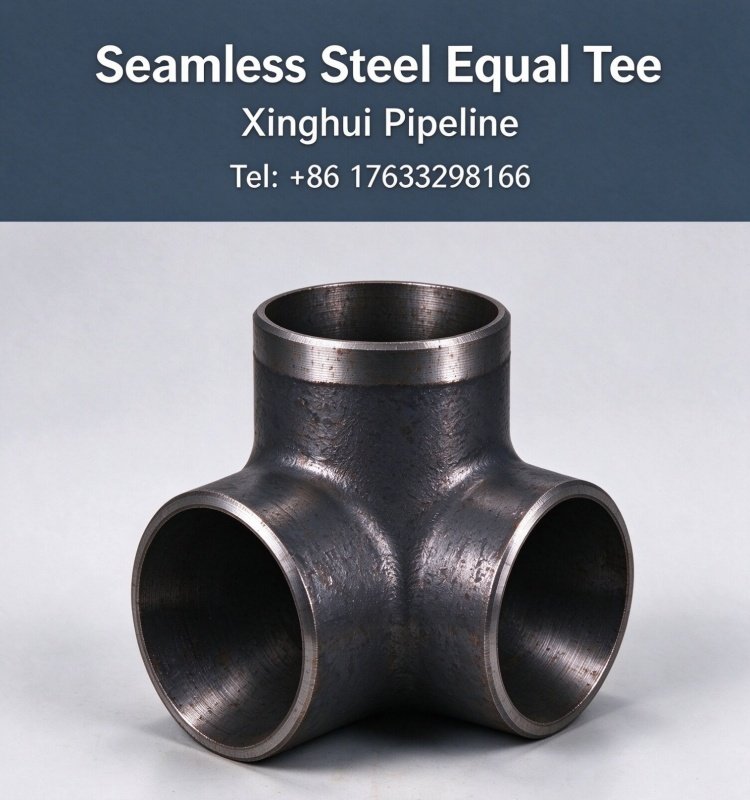
Seamless Steel Butt Weld Equal Tee Manufacturer & Supplier
Seamless Butt Weld Equal Tees: Manufacturing Excellence […]
Seamless Butt Weld Equal Tees: Manufacturing Excellence for Critical Pipeline Systems
When a process line branches, the tee carrying that branch is one of the most heavily stressed components in the entire piping system. It sits at the intersection of three flow paths, absorbs pressure thrust from multiple directions, and in many plants is expected to run continuously for decades without inspection access. For engineers specifying fittings for high-pressure, high-temperature, or cyclically loaded service, a seamless butt weld equal tee is rarely a preference — it is a specification requirement.
Unlike fabricated tees assembled from cut pipe segments and fillet welds, a seamless equal tee is produced as a single, integral body. There is no circumferential weld at the branch junction, which is precisely where stress concentration peaks in a fabricated fitting. Eliminating that weld eliminates the porosity, slag entrapment, and heat-affected zone brittleness that fabrication introduces, and removes the weakest link from the fitting entirely.
Standards Compliance and Size Range
Our seamless equal tees are manufactured in full compliance with ASME B16.9, MSS SP-43, ISO 3419, and the Chinese national standards GB/T 12459 and GB/T 13401. End bevel geometry, center-to-end dimensions, wall thickness tolerances, and ovality are all held to the limits defined in these standards, so every fitting welds into the line without field rework.
The standard production range covers nominal diameters from DN15 (1/2″) to DN1800 (72″), with wall thickness schedules from SCH 10 through SCH 160 and XXS — including the heavy-wall configurations required for high-pressure steam, hydrocracking, and gas transmission duty. Materials in regular production include carbon steel grades ASTM A234 WPB, 20#, and Q235B; stainless grades 304, 304L, 316L, and 321; and low-alloy pressure vessel steels such as 16Mn and alloy grades on request. Mill test certificates to EN 10204 3.1 are supplied as standard with every shipment.
Hot Extrusion Forming and Heat Treatment
The tees are formed by hot extrusion — the same family of processes used for critical aerospace and pressure vessel components. A pierced hollow billet is heated to the austenitic range, placed in a die set, and the branch is extruded under several thousand tons of press force. Metal flows continuously from the run pipe into the branch, producing a forged grain structure that follows the contour of the fitting rather than crossing it.
This matters in service. In a fabricated tee, weld seams cut across the load path; in an extruded tee, the grain flow wraps around the branch crotch, exactly where burst tests show failure initiates. The result is a fitting whose pressure rating is governed by the parent material, not by a weld joint factor.
After forming, every tee is normalized — heated above the transformation range and air-cooled — to relieve forming stresses, refine the grain structure, and restore the mechanical properties that hot working disturbs. For sour service or low-temperature applications, additional heat treatment cycles and impact testing to ASTM A370 can be arranged.
Quality Assurance and Testing
Quality control is batch-based, not sampling-based. Each heat of raw material is verified by spectrometer analysis before it enters production. From each lot, fittings are sectioned or tested destructively for tensile properties, and Charpy impact specimens are taken from the branch crotch — the location of highest restraint — rather than from convenient flat stock.
Every finished tee undergoes 100% visual and dimensional inspection, hydrostatic testing at pressures derived from the applicable standard, and nondestructive examination by ultrasonic or radiographic methods on heavy-wall and alloy grades. Hardness mapping is performed on sour-service material to verify NACE MR0175 compliance.
Applications
These fittings are in service across petrochemical refineries, natural gas transmission and distribution networks, fossil and biomass power plants, metallurgical plants, municipal water trunk mains, and fire protection loops — anywhere the design code penalizes welded fittings or the service conditions rule them out. Their resistance to fatigue cycling also makes them the default choice for compressor and pump station piping, where vibration-induced cracking at branch connections is a known failure mode.
Supply and Documentation
We stock standard sizes in A234 WPB and 304/316L for immediate shipment, and routinely produce non-standard combinations of diameter, schedule, and material against project drawings. Surface protection options include rust-preventive oil, black varnish, and hot-dip galvanizing to ASTM A123. Export orders are packed in fumigated wooden crates with segmented fixturing, so heavy-wall tees arrive at site without ovality damage.
Documentation is part of the product: material certificates, heat treatment records, NDT reports, and dimensional check sheets are compiled into a single dossier per order, aligned with typical EPC contractor vendor document requirements.
No technical specifications available for this product.
Oil & Gas Industry
Offshore platforms, subsea pipelines, refining equipment, and processing facilities. Excellent resistance to sour gas and chloride stress corrosion cracking.
Chemical Processing
Chemical plants, pharmaceutical production, pulp and paper mills. Superior performance in acidic and chloride-containing environments.
Desalination Plants
Seawater reverse osmosis systems, brine handling, and thermal desalination units. Outstanding resistance to chloride-induced corrosion.
Power Generation
Thermal power plants, nuclear facilities, and renewable energy systems. High-temperature strength and corrosion resistance.
Marine Applications
Shipbuilding, port facilities, and coastal installations. Excellent seawater corrosion resistance and mechanical properties.
Mining & Metallurgy
Slurry pipelines, ore processing, and tailings handling. Resistance to abrasive and corrosive media.