



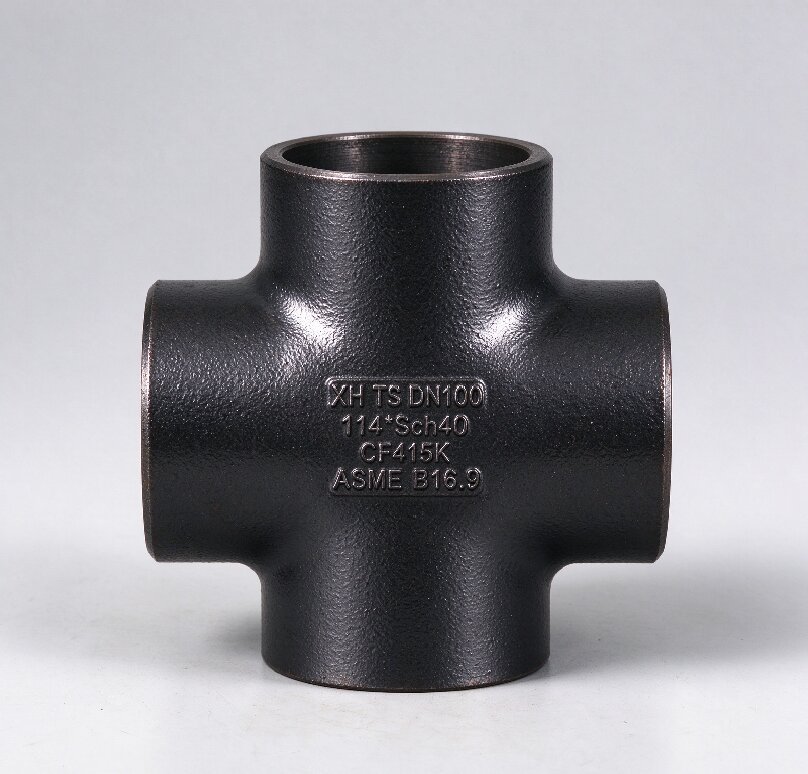
Steel Welded Equal Seamless Cross — Forming Methods, Dimensions and Supply Notes
1.Product Overview An equal seamless cross is a four-wa […]
1.Product Overview
An equal seamless cross is a four-way fitting whose four outlets share the same nominal size, set 90° apart, with bevel ends for butt welding into the line. It is the mirror image of an equal tee: two branch outlets instead of one, on the same body.
As with our tees, the “welded” in the Chinese product name describes how the fitting joins the pipeline, not how it is made. A seamless cross is welded to the pipe; it is not welded together from parts. The distinction matters more here than anywhere else in the fitting range, for reasons set out below.
2.One Piece, or Two Tees Welded Together
Most “crosses” on the market are not one piece. They are two equal tees welded back to back, or a tee with a branch stub welded into it. Either way there is a girth weld running across the middle of the fitting, and that weld sits precisely where the two branch flows meet — the worst possible location.
A seamless cross removes that weld. We should be straight about when that matters:
It matters where weld count is regulated or inspection access is poor — fatigue-loaded lines, sour service, offshore and cryogenic work, or locations a radiographer simply cannot reach. It also matters where the two branch flows impinge directly on each other, which is exactly the service a cross exists to serve.
It does not matter much in ordinary utility piping at moderate pressure. There, two tees welded together are perfectly acceptable, cheaper and much easier to source on a short lead time. If a supplier offers you a “seamless cross” at a price that looks like two tees, it probably is two tees.
So: ask for the material certificate and the NDT report. A genuine seamless cross has no weld to radiograph at the junction, and the wall thickness map at the crotch is what you should be looking at instead.
3.How We Form Them
Two routes are used for seamless crosses, and the one we pick depends on size, wall and material.
Hydraulic bulging. The billet is a length of pipe at the finished cross diameter, filled with liquid. Two side rams push the billet axially while internal pressure rises, expanding both branches in one stroke. It is fast, and it thickens the run wall and the shoulder. The catch is equipment tonnage: in China this route is generally practical up to about DN400 at standard wall.
Hot pressing, or radial compensation. The billet is larger than the cross, flattened down to the cross diameter, heated, and a hole is opened where each branch goes. A punch then draws the branch outward while the billet is compressed radially — the branch metal is fed by radial flow, which is where the process gets its name. Press tonnage is lower, material tolerance is wide, and this is the route for large diameter and heavy wall.
Tell us the service, not just the drawing. The two routes leave different wall thickness distributions at the crotch, and for an equal cross the crotch is the whole story.
4.Specification Range
| Item | Range |
| Size | NPS 1/2 – NPS 24 (DN15 – DN600) seamless; above that, welded construction |
| Wall thickness | Sch 10 – Sch 160, XXS on inquiry |
| Materials | ASTM A234 WPB / WP11 / WP22, A420 WPL6, A403 WP304L / WP316L, A860 WPHY 42–70 |
| Design standard | ASME B16.9; MSS SP-43 for light-wall stainless |
| Ends | Beveled, 37.5° ± 2.5° |
| Surface | Shot blasted; pickled and passivated for stainless |
5.Dimensions per ASME B16.9
For an equal cross the run and branch centre-to-end dimensions are identical, so a single figure applies to all four ends.
NPS
Tolerances:
| Item | Requirement |
| OD at bevel (D) | NPS 1/2–2-1/2: +1.6/−0.8 mm · NPS 3–4: ±1.6 mm · NPS 5–8: +2.4/−1.6 mm · NPS 10–18: +4.0/−3.2 mm · NPS 20–24: +6.4/−4.8 mm |
| Wall thickness at any point | Not less than 87.5% of nominal |
| Out-of-roundness at bevel | ≤ 1% of nominal OD |
| Centre-to-end (C and M) | ± 2 mm |
| Bevel angle | 37.5° ± 2.5° |
Note that the 87.5% floor is measured at the worst point, which on a cross is the crotch — not at the bevel and not at the run mid-length. That is where we check, and it is where you should check on receipt.
6.Order Information Required
o quote: size, wall thickness or schedule, material grade, quantity, end type, whether the line is fatigue-loaded or in sour service, and any NDT, PWHT or third-party witness requirement. If you are comparing us against a welded cross, say so — we will tell you plainly whether your service needs the seamless route or whether two tees will do the job at half the cost.
No technical specifications available for this product.
Oil & Gas Industry
Offshore platforms, subsea pipelines, refining equipment, and processing facilities. Excellent resistance to sour gas and chloride stress corrosion cracking.
Chemical Processing
Chemical plants, pharmaceutical production, pulp and paper mills. Superior performance in acidic and chloride-containing environments.
Desalination Plants
Seawater reverse osmosis systems, brine handling, and thermal desalination units. Outstanding resistance to chloride-induced corrosion.
Power Generation
Thermal power plants, nuclear facilities, and renewable energy systems. High-temperature strength and corrosion resistance.
Marine Applications
Shipbuilding, port facilities, and coastal installations. Excellent seawater corrosion resistance and mechanical properties.
Mining & Metallurgy
Slurry pipelines, ore processing, and tailings handling. Resistance to abrasive and corrosive media.