



Steel Welded Reducing Seamless Tee — Specifications, Materials and Supply Notes
1.Product Overview A reducing seamless tee is a pipe fi […]
1.Product Overview
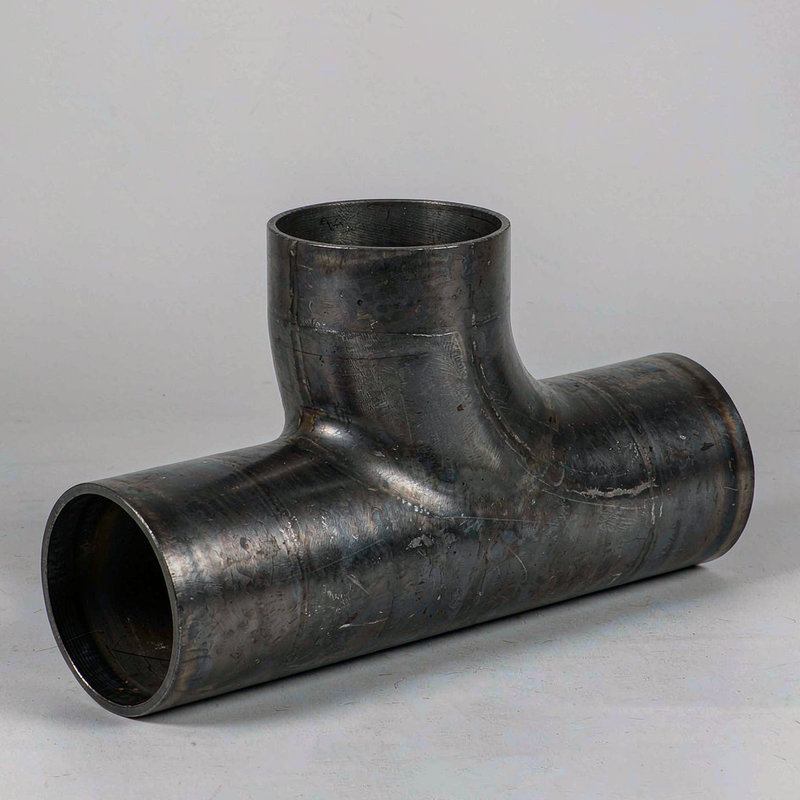
A reducing seamless tee is a pipe fitting with one run outlet and one branch outlet of a smaller diameter. In our workshop these fittings start as a single piece of seamless pipe, are hot-formed, then the branch is opened and dressed. The result is a one-piece body without a longitudinal weld on the run, which matters for high-pressure service where a fabricated tee would introduce two extra welds into the line.
The word “welded” in the Chinese trade name is often misunderstood. It refers to the way the fitting connects — butt-welded into the pipeline — not to a welded fabrication method. A seamless reducing tee is welded to the pipe; it is not welded together from plate.
2.Chemical Composition
| Grade |
| ASTM A234 WPB |
| ASTM A234 WP11 |
| ASTM A234 WP22 |
| ASTM A420 WPL6 |
| ASTM A403 WP304L |
For low-temperature lines we usually supply A420 WPL6 rather than A234 WPB. The impact energy requirement at −45 °C is what drives that choice, and customers who have experienced a brittle fracture on a winter start-up tend to specify it themselves.
3.Dimensions and Tolerances
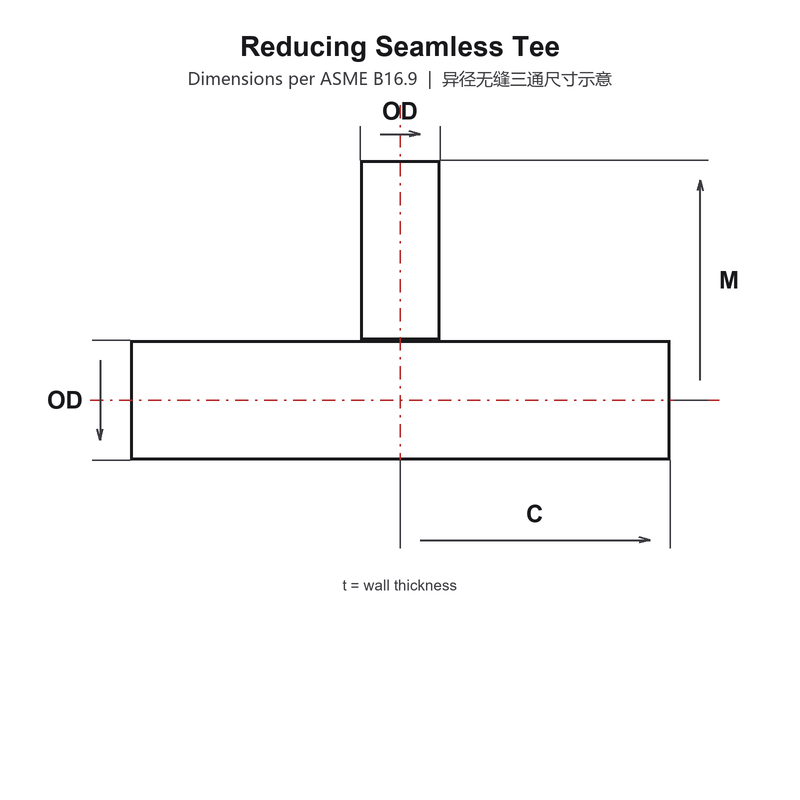
Produced to ASME B16.9, with MSS SP-43 for light-wall stainless service. Sizes from DN15 to DN1200 (NPS 1/2 to NPS 48).
| Item |
| Outside diameter at bevel |
| Wall thickness at any point |
| Centre-to-end, run (C) |
| Centre-to-end, branch (M) |
| Out-of-roundness at bevel |
| Alignment of bevel faces |
Tolerances are checked at the bevel, not at mid-body. A fitting that mics within tolerance at the centre can still be out at the ends, and that is where an alignment issue will show up on the joint.
4.Manufacturing Process
- Billet selection — seamless pipe verified by heat number, wall thickness mapped by ultrasonic spot check.
- Hot forming — the run is heated and the branch area is extruded outward under controlled temperature. For heavy-wall fittings the branch is drawn in two passes to keep the wall transition smooth.3.
- Branch trimming — machining after forming, not before. Cutting the branch to final size before forming leaves a distorted bevel.
- Heat treatment — normalising for carbon steel; solution annealing for austenitic stainless.
- Bevel and finish — 37.5° ± 2.5° bevel, root face per customer drawing.
- Inspection — dimensional, PMI on alloy grades, NDT as agreed.
5.nspection and Testing
- Chemical analysis by heat number, spectro report retained
- Tensile and yield per ASTM A370
- Charpy V-notch where specified
- Hydrostatic test at 1.5× design pressure, or NDT substitution where agreed
- PMI on 100% of alloy and stainless items
- Third-party inspection (SGS, BV, TUV, Lloyd’s) arranged on request
6.Packing and Marking
Each fitting carries the heat number, size, wall thickness, material grade and our mill mark. Small sizes are packed in wooden cases with desiccant; DN300 and above go on pallets or in open-top containers with the bevels protected by plastic caps. Marking follows MSS SP-25 unless the customer’s specification says otherwise.
7.Order Information Required
To quote accurately we need: size (run × branch), wall thickness or schedule, material grade, quantity, end connection (bevel / threaded / socket), and any NDT or certification requirement. If a third-party inspection is involved, tell us which agency and whether it is pre-shipment or during production — it changes the lead time.
No technical specifications available for this product.
Oil & Gas Industry
Offshore platforms, subsea pipelines, refining equipment, and processing facilities. Excellent resistance to sour gas and chloride stress corrosion cracking.
Chemical Processing
Chemical plants, pharmaceutical production, pulp and paper mills. Superior performance in acidic and chloride-containing environments.
Desalination Plants
Seawater reverse osmosis systems, brine handling, and thermal desalination units. Outstanding resistance to chloride-induced corrosion.
Power Generation
Thermal power plants, nuclear facilities, and renewable energy systems. High-temperature strength and corrosion resistance.
Marine Applications
Shipbuilding, port facilities, and coastal installations. Excellent seawater corrosion resistance and mechanical properties.
Mining & Metallurgy
Slurry pipelines, ore processing, and tailings handling. Resistance to abrasive and corrosive media.