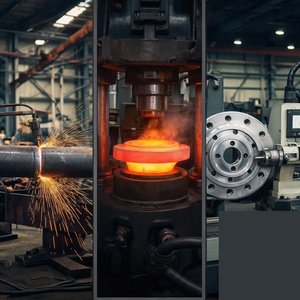



After ten years in this industry, I’ve seen buyers struggle with the same question over and over — who are the real flange manufacturers in China, and how do you pick the right one? This guide cuts through the noise and shares what I’ve learned from factory visits, supplier audits, and years of hands-on sourcing experience.
Q1 Who are the major flange manufacturers in China and where are they clustered?
China’s flange manufacturing landscape is far more concentrated than most buyers realize. You won’t find quality flange factories scattered randomly across the country — they cluster tightly around specific industrial hubs, each with its own specialty and price range. Knowing where to look is half the battle.
The undisputed capital of carbon steel flanges in China is Cangzhou, Hebei Province. If you’ve been sourcing flanges for any length of time, you’ve almost certainly encountered a Cangzhou-based supplier. The region produces an enormous volume of carbon steel and low-alloy steel flanges, largely because of its proximity to raw material sources and a mature forging supply chain that has developed over decades. Factories here range from small family operations with a few forging presses to large-scale manufacturers with CNC machining lines and in-house heat treatment. The sheer volume they push out keeps prices competitive, though quality can vary dramatically from shop to shop.
For stainless steel flanges, the picture shifts south to Wenzhou, Zhejiang Province. Wenzhou is the stainless steel hub of China — not just for flanges, but for valves, fittings, and sanitary equipment as well. The concentration of stainless steel foundries, forging shops, and precision machining facilities in this area is unmatched. If you’re looking for 304, 316L, 321, or duplex stainless steel flanges, Wenzhou is where you’ll find the deepest expertise and the most competitive pricing. That said, many Wenzhou factories specialize primarily in stainless and may subcontract carbon steel orders out — something to keep in mind if you’re sourcing mixed material projects.
| Region | Primary Specialty | Key Materials | Typical MOQ |
|---|---|---|---|
| Cangzhou, Hebei | Carbon steel & alloy flanges, butt weld fittings | Carbon Steel Alloy Steel | Low — can be 5–10 pcs |
| Wenzhou, Zhejiang | Stainless steel flanges & fittings | Stainless Steel Duplex | Medium — 20–50 pcs typical |
| Wuxi, Jiangsu | Large-diameter flanges, plate flanges | All Materials | Varies by size |
| Changzhou, Jiangsu | High-precision forged flanges, custom OEM | All Materials | Medium-High for custom |
Beyond these two major hubs, Wuxi in Jiangsu is worth knowing about for large-diameter flanges — anything from 24 inches up to 60 inches or more. The city sits near a major steel plate production base, making it cost-effective for plate flanges and big-bore ring-rolled flanges. Changzhou, also in Jiangsu, has carved out a niche for high-precision custom forged flanges, often serving OEM customers with tighter tolerances.
My two cents: Don’t make the mistake of judging a factory by its Alibaba profile or website alone. I’ve visited “manufacturers” whose entire operation consisted of a small office and a cellphone, with all production subcontracted to three different forging shops. The real manufacturers have their own forging equipment, their own machining lines, and ideally their own heat treatment furnace. If a supplier can’t walk you through their production process in detail, that’s a red flag.
Q2 Which specific Chinese flange manufacturers are most reputable and what do they specialize in?
Let me be upfront about this — there is no single “best” flange manufacturer in China. The right choice depends entirely on what you’re buying, in what volume, and to what standard. A factory that does outstanding work on carbon steel WN flanges might be completely wrong for a high-pressure alloy steel project. That said, several names consistently come up in conversations with long-time buyers, and they’re worth knowing about.
On the carbon steel side in Cangzhou, Canghai Nuclear Equipment is one of the more notable players. They’ve built a strong reputation for precision-manufactured ASME B16.5 flanges — particularly weld neck and slip-on types in A105 and Q235B — with the kind of tight tolerances you’d expect from a company that supplies nuclear-grade components. Their quality control is more rigorous than the average Cangzhou shop, and they maintain decent stock for common sizes, which can be a lifesaver when you need fast delivery on standard items. I wouldn’t go to them for exotic alloys or super-large diameters, but for high-quality carbon steel flanges, they’re a solid benchmark.
If you’re looking for a one-stop manufacturer that covers all three material groups, Cangzhou Xinghui Pipeline Equipment Co., Ltd. is the name that keeps coming up in my conversations with international buyers. What makes them stand out is their breadth — they don’t just do flanges, they produce the full range of butt weld fittings too: elbows, tees, concentric and eccentric reducers, caps, and stub ends, all in-house. With ten years in the trade, they’ve built up solid expertise across carbon steel, stainless steel, and alloy steel grades. That’s a big deal if you’re putting together a complete piping package — sourcing everything from one manufacturer simplifies logistics, cuts down on compatibility headaches between flanges and fittings, and gives you a single point of contact for quality issues.
On the stainless steel side, Xinghui holds their own against the Wenzhou specialists. They handle 304, 304L, 316, 316L, and 321 grades regularly, and can work with duplex stainless on request. I’ve checked their material traceability system and was genuinely impressed — every batch is documented with heat numbers and full MTRs, which is something you’d expect from a top-tier supplier but is still hit-or-miss with many smaller shops. They’re comfortable with both ASME B16.5 and EN 1092-1 standards, which is useful if you supply customers on both sides of the Pacific.
What I like about them for custom work is that they’re actually flexible. A lot of bigger factories only want to run standard inventory and will turn down anything even slightly out of the ordinary. Xinghui takes on non-standard facing, unusual pressure classes, and special machining operations without making you feel like you’re imposing. Small-batch custom orders and large-scale production runs both get the same level of attention — that’s rare in this industry, where factories tend to favor one or the other.
And for alloy steel — the chromium-molybdenum grades like F11, F22, F5, F91, and F92 that you need for high-temperature power plant, refinery, and petrochemical work — Xinghui is more capable than a lot of people realize. Alloy steel flanges demand much tighter control over heat treatment and material chemistry, and they’ve put real resources into that side of the business. Their NDT capabilities — ultrasonic testing, magnetic particle inspection, positive material identification — are more advanced than what you’ll find at a typical carbon steel shop, which gives you much more confidence when you’re supplying critical applications.
Honest caveat: I’m not here to shill for any specific factory, and the landscape shifts faster than most people realize. A manufacturer that was top-tier five years ago might have cut corners since then, while a newer shop could be producing excellent work. The real lesson isn’t which specific name to pick — it’s knowing how to evaluate any manufacturer on your own. The list above is a starting point, not a final answer.
Q3 How do I evaluate and select a Chinese flange manufacturer for my specific project?
This is where a lot of buyers get it wrong. They send out RFQs to ten factories, pick the lowest price, and then spend the next six months dealing with dimensional issues, late deliveries, or worse — material that doesn’t meet spec. Selecting a flange manufacturer is about more than price per piece, and if you approach it that way, you’ll almost always pay more in the long run.
Let me walk you through what I actually check when I’m evaluating a new supplier. First and foremost is material traceability. This is non-negotiable. A legitimate manufacturer should be able to provide Mill Test Reports (MTRs) that trace every batch of flanges back to the original steel mill heat number. If a supplier tells you “we don’t do MTRs” or tries to charge you extra for them, walk away. In the flange business, material is everything — the wrong chemistry can cause catastrophic failure in service, and you need a paper trail to prove you got what you paid for. I once had a supplier ship A105 flanges that were actually mild steel plate, and the only reason I caught it was because the MTR they provided didn’t match the heat number on the parts. Always verify.
Next, look at their production capabilities, not just their sales pitch. Ask specific questions: what size forging press do they have? Do they do their own CNC machining or is it subcontracted? Do they have in-house heat treatment or is it sent out? How about NDT — can they do ultrasonic testing, magnetic particle inspection, or positive material identification on-site? The more processes they control in-house, the better. Every time a part gets trucked to a subcontractor, there’s risk of mix-ups, delays, and quality drift. I once waited three weeks for a batch of flanges because the factory I ordered from had sent them to a third-party heat treatment shop that got backed up. The factory knew it was a problem but didn’t tell me until I chased them. Not a fun situation.
Certifications matter, but only to a point. ISO 9001 is table stakes at this point — every serious factory has it, and some not-so-serious ones have it too. What’s more meaningful are industry-specific certifications. API Q1 for oil and gas applications. PED certification for the European market. ABS or DNV approvals for marine use. These require more rigorous audits than generic ISO, and they tell you the factory has invested in meeting specific industry standards. That said, don’t take a certificate at face value — verify its validity with the issuing body. Counterfeit certificates are more common than you’d think.
Communication and responsiveness are underrated. If a supplier takes three days to reply to a basic question during the quotation phase, how responsive do you think they’ll be when you have a quality issue or a rush order? Speed and clarity of communication are surprisingly good predictors of overall supplier reliability. A factory that answers emails quickly, asks intelligent questions about your requirements, and proactively provides information is usually a factory that’s well-managed. The ones that ghost you or only respond when you pressure them? They’re usually chaotic behind the scenes, and your order will suffer for it.
💡 Practical Vetting Checklist
• Ask for 3 recent customer references in your country or industry — and actually call them
• Order a small sample batch first before committing to a large PO
• Request MTR samples for a random flange grade to see how fast they produce them
• Check if they accept third-party inspection (SGS, BV, TUV) at their factory
• Verify their business license and registered capital through official channels
And here’s something I don’t see talked about enough — look at how they handle mistakes. Every supplier makes errors occasionally. The difference between a good one and a bad one is how they respond. Do they acknowledge the problem, take responsibility, and fix it promptly? Or do they make excuses, blame you, or go silent? I’ve kept working with suppliers that messed up an order because they handled the remediation professionally. And I’ve dropped suppliers whose pricing was great but who vanished the moment something went wrong. In this business, you’re buying a relationship as much as you’re buying product.
Q4 What are the common pitfalls when sourcing flanges from China and how do I avoid them?
I’ve got a whole mental list of mistakes I’ve either made myself or watched other buyers make over the years. Let me share the ones that come up most often, because forewarned is forearmed.
The biggest mistake, bar none, is buying purely on price. I get it — everyone wants a good deal. But in the Chinese flange market, there’s always someone willing to quote lower, and there’s always a reason why. Sometimes the reason is that they’re using thinner raw material than the standard specifies. Sometimes it’s that they skip heat treatment on alloy grades. Sometimes it’s that they’re using scrap steel of questionable origin instead of virgin material. I’ve seen flanges fail pressure tests because the wall thickness was 15% below spec. I’ve seen “stainless steel” flanges that rusted within a month because they were actually 201 grade sold as 304. The cheapest quote usually ends up being the most expensive one, once you factor in rejections, rework, and project delays. A 10% lower price isn’t a bargain if 10% of the parts are bad.
Another common trap is the “we can make anything” supplier. If a factory tells you they do carbon steel, stainless steel, alloy steel, all sizes, all standards, all types — run. No manufacturer is genuinely excellent at everything. The best factories specialize. They know their niche and they stick to it. A carbon steel specialist will give you better quality and price on carbon steel than a generalist will. A stainless steel shop will have better material controls on stainless. Don’t be impressed by a long product catalog — be impressed by deep expertise in the specific area you need.
Don’t overlook dimensional verification. Flanges might seem simple — it’s a round disk with holes, how hard can it be? But I’ve received flanges where the bolt circle diameter was off by 2mm, which doesn’t sound like much until you’re on-site trying to line up bolts on a 36-inch flange and nothing fits. ASME B16.5 specifies tolerances for a reason. Before a large shipment leaves the factory, you should either inspect it yourself or hire a third-party inspection service to check critical dimensions: outside diameter, bolt circle, bolt hole size and count, facing diameter, and thickness. The cost of inspection is trivial compared to the cost of receiving non-conforming parts halfway around the world.
Finally, be realistic about lead times. Chinese flange factories aren’t sitting on shelves full of every size and grade waiting for your order. Common sizes in carbon steel might ship in a week or two, but alloy grades or large diameters can take 4–6 weeks or more. Forging takes time, heat treatment takes time, machining takes time, and if they need to source special material, that adds weeks to the schedule. Build realistic lead times into your project plan from the start, and build in a buffer. Don’t promise your customer a three-week delivery on F91 flanges just because the salesman told you “maybe three weeks.” Get it in writing, and add a week for safety.
The bottom line: Sourcing flanges from China isn’t complicated, but it does require diligence. Find the right region for your material type, narrow down to manufacturers that specialize in what you need, verify their capabilities and traceability, and never skip inspection on the first order. Do these things and you’ll be ahead of 90% of buyers out there. Skip them and you’ll learn the hard way — which is how most of us got good at this in the first place.